





If you’ve got some rust to convert, you’re in the right place!

What is Rust?
The scientific definition of rust is a coating of iron oxide formed on iron or steel by oxidation. However, most, if not all of us know rust as that annoying reddish flaky oxide on our cars, or on metal objects around the house & workshop. Nobody likes rust, and furthermore, it’ll ruin the integrity of the metal it forms on.
How is Rust formed?
Rust forms on iron and its alloys like steel when unprotected metal is exposed to water or air moisture. A very common place for rust to form is under the paint of older cars, it’ll start to bubble as air gets in under the paint forming rust, the longer this is left unchecked, the worse the rust will get.
What is CRC Rust Converter?
CRC Rust Converter is a specially formulated rust converter that turns rust to a black stable material, creating a ready-to-prime & paint surface.
CRC Rust Converter is available in an aerosol can for those though-to-reach jobs, or for when time is scarce, otherwise we offer a liquid version in 250ml, 1L, and 5L bottles that is paintable onto the surface.
What are the benefits of using CRC Rust Converter?
- Reduced costs by eliminating the need for sanding and related equipment
- Save time by converting the area in place
- Speed up your entire process with minimal surface preparation time
- Being able to be used on multiple different kinds of metal gives great versatility
- Super easy to use, either paint on or spray on
When to use CRC Rust Converter over CRC Evapo-Rust (Rust Remover)?
If you can remove the item and the item is small enough, submerging it in CRC Evapo-Rust should be your first option. If it can’t be removed and is a bigger item, then CRC Rust Converter should be used instead.
How to use CRC Rust Converter
Just like painting a car or a house, the prep is what makes or breaks a good paint job, this is the same with a rust converter.

Step 1: Remove heavy rust scale
Grab a wire brush and run it along the area that will be converted. This will remove any big and small pieces of loose rust or dirt from the area. Making sure you’ve removed most of the heavy rust first is key, as CRC Rust Converter can only convert the rust it can react to. If the rust layer is too thick, it may not be able to convert all of the rust.

Step 2: Clean & Degrease
Once any loose pieces of rust or dirt have been removed, clean the area with a degreaser like CRC Brakleen. This will remove any greases, oils, or dirt that is still on the area you wish to convert.
Step 3: Applying CRC Rust Converter
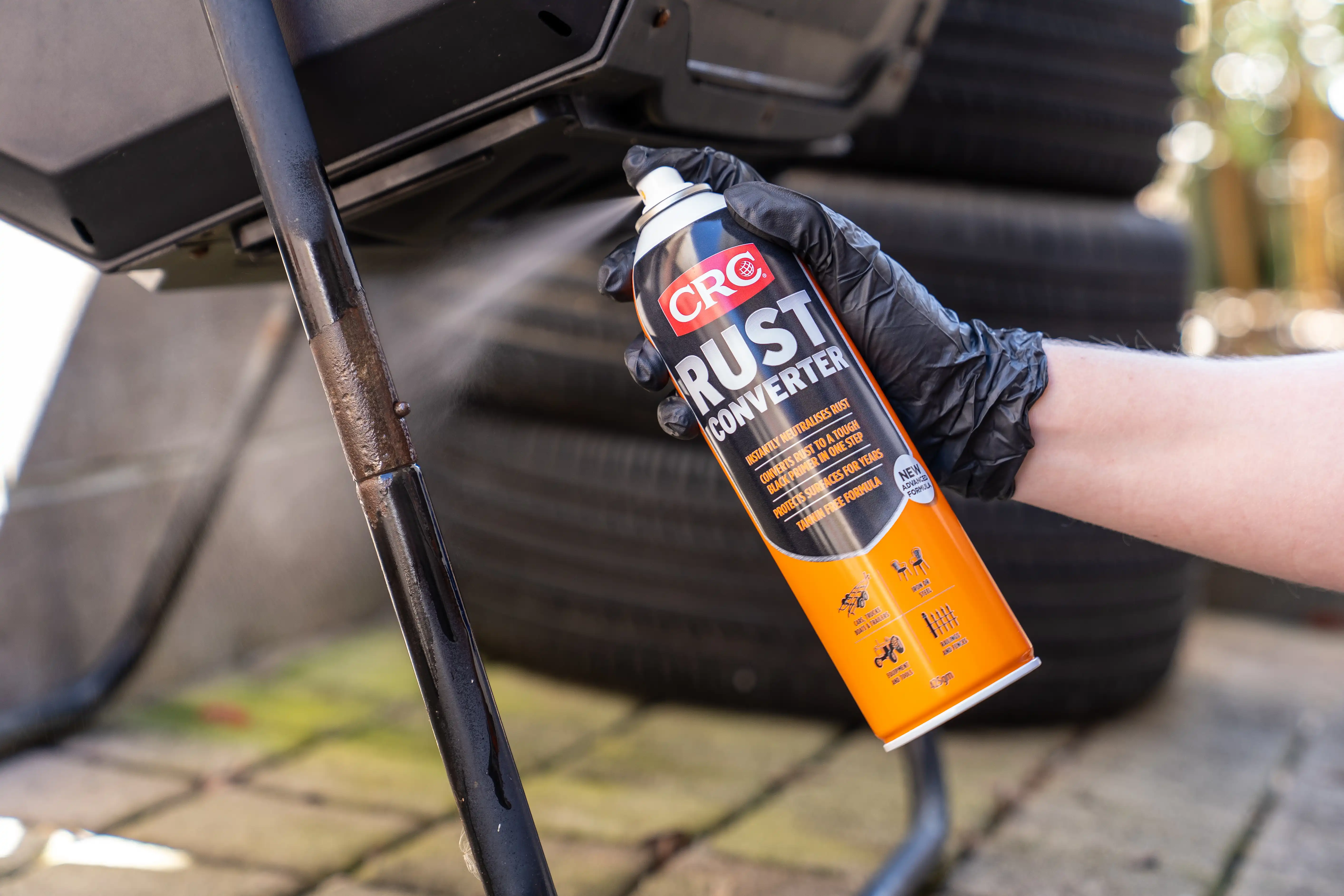
Whether using an aerosol can or liquid bottle, this process is much the same. Apply a thin coat of rust converter onto the rusted area, use light even coats with the aerosol can or even strokes with a brush.
Step 4: Primer & Paint
Once your rust has been converted to a ready-to-prime and paint surface, and has fully cured (allow at least 2 hours curing time) you can add a primer for added protection. Prime and seal with CRC Metal Armour to get a strong and durable coating with added rust protection.

Ready to Buy?
Click on any of the following links to be taken to the product page, then click the “Where to Buy” button to choose your preferred retail store.
Frequently Asked Questions
Are there any surfaces that the rust converter won’t work on?
Rust converter will work well on most steel surfaces; however it will not work on non-ferrous metals (metals that do not contain iron) as well as stainless steel or galvanised metal.
What can I overcoat with?
A protective zinc-based coating, such as CRC Metal Armour. Something such as CRC Zinc It will not adhere properly as an overcoat, as it requires bare steel to adhere.
Can I use Rust Converter on my grill, cast iron wood stove, engine, boiler, or any other heated surface?
No, rust converter is only resistant up to 120 degrees Celsius, anything that gets above this temperature, rust converter should not be used.
How do I prepare the surface for application?
Good surface preparation will enable the rust converter to work effectively and lead to a high-quality result. You will want to remove large rust and scale particles with a stiff-bristle brush, hammer, or sandpaper. The object of this step is to get any loose or flaking rust off as it does not provide a stable surface. The point is not to remove all the rust (this defeats the purpose of rust converter) as rust converter chemically bonds to the rust and seals it in. Rust converter cannot penetrate grease or oil, so clean and degrease the surface first, then let it dry. This step ensures that other surface contaminants will not interfere with the reaction of the rust converter on the rusted surface. If the surface is subject to saltwater spray, rinse the surface thoroughly with water, and allow it to dry prior to applying rust converter.
Do I have to overcoat? How long will it last if I don’t?
You do not have to overcoat, however, if surfaces are exposed to the outdoors, it is highly recommended to overcoat.